Energy Meter Constant Calculator (imp/kWh to Load kW)
 By Santaji Gadepatilin
Updated November 2, 2026
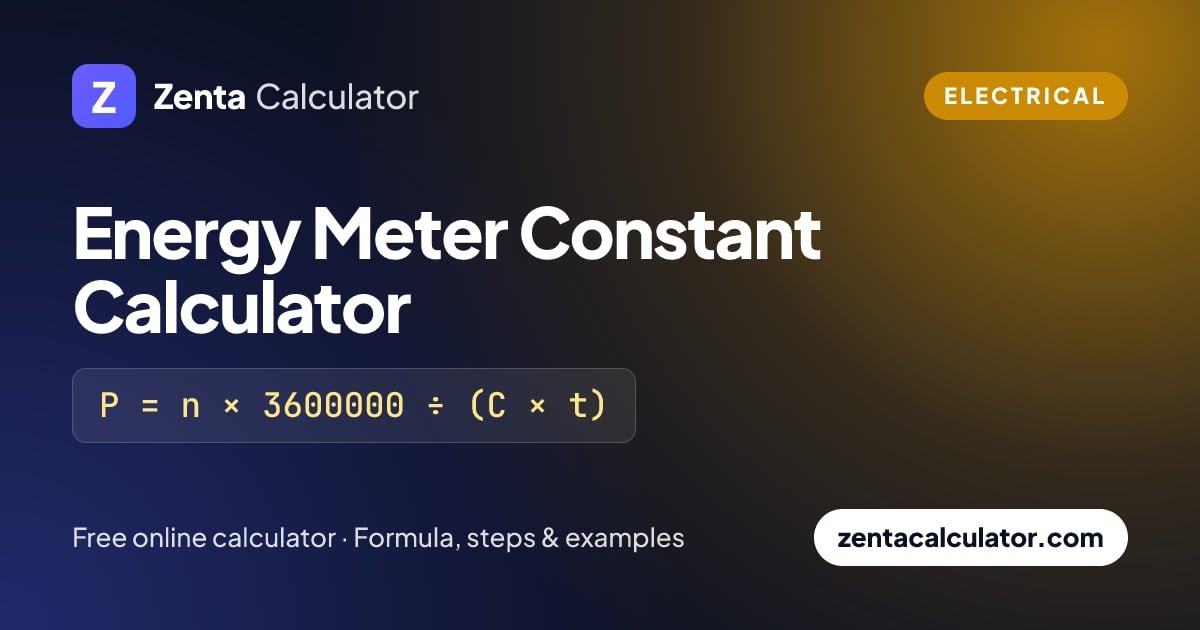
Every electricity meter has a constant, printed as imp/kWh (pulses) or rev/kWh (disc turns), that says how many pulses mean one kilowatt-hour. This energy meter constant calculator converts pulses counted over a time into load power and energy, and compares it with a reference load to give the meter error — useful alongside an electrical energy consumption calculation.
How to use the energy meter constant calculator
Enter the meter constant from the nameplate, the number of pulses (or disc revolutions) you counted and the time you counted for. The calculator returns the load power the meter is registering and the energy recorded. Add a reference load from a calibrated instrument to see the meter’s percentage error and the expected time between pulses.
Meter constant formulas
P (kW) = 3600 × n ÷ (C × t) · E (kWh) = n ÷ C
Error = (Pmeter − Pactual) ÷ Pactual × 100%
Example
A 3,200 imp/kWh meter flashes 32 times in 30 s while a reference wattmeter reads 1.19 kW:
- P = 3600 × 32 ÷ (3200 × 30) = 1.20 kW
- Energy recorded = 32 ÷ 3200 kWh = 10 Wh
- Error = (1.20 − 1.19) ÷ 1.19 = +0.84% (the meter reads high)
- At 1.19 kW the LED should flash every 0.945 s
Time between pulses
| Meter constant | at 100 W | at 1 kW | at 5 kW |
|---|---|---|---|
| 100 imp/kWh | 360 s | 36 s | 7.2 s |
| 400 imp/kWh | 90 s | 9 s | 1.8 s |
| 800 imp/kWh | 45 s | 4.5 s | 0.9 s |
| 1,000 imp/kWh | 36 s | 3.6 s | 0.72 s |
| 1,600 imp/kWh | 22.5 s | 2.25 s | 0.45 s |
| 3,200 imp/kWh | 11.2 s | 1.12 s | 0.225 s |
| 6,400 imp/kWh | 5.62 s | 0.562 s | 0.113 s |
| 10,000 imp/kWh | 3.6 s | 0.36 s | 0.072 s |
Testing tips
- Count for at least 60 s or 20 pulses to keep timing error below about 1%.
- Use a purely resistive, steady load; motor or switching loads fluctuate.
- For three-phase meters, apply a balanced load or test each element separately.
- To turn monthly kWh into load factor and demand figures, use the load factor calculator.
Frequently asked questions
How do I calculate load from the meter's pulse LED?
P (kW) = 3,600 × pulses ÷ (meter constant × seconds). With 3,200 imp/kWh, 32 pulses in 30 s means 1.2 kW.
What does 3200 imp/kWh mean?
The LED flashes 3,200 times for every kilowatt-hour recorded, so each pulse is 1 ÷ 3,200 kWh = 0.3125 Wh.
How do I check if my energy meter is accurate?
Run a known, steady load (a heater measured with a calibrated wattmeter), count pulses for at least a minute and compare. Error = (meter reading − actual) ÷ actual. Class 1 meters must be within ±1%.
What about CT-operated meters?
For a meter on current and voltage transformers, the constant refers to the secondary side. Multiply the result by the CT ratio × PT ratio to get the primary power.
Related calculators
- ElectricalLoad Factor CalculatorCalculate load factor from energy consumed and maximum demand, plus average load and demand factor, for monthly electricity bills and plant studies.Open calculator
- ElectricalAmps to Watts CalculatorConvert amps to watts for DC, single-phase and three-phase circuits, with charts for 12 V, 120 V and 230 V.Open calculator
- ElectricalkW to Amps CalculatorConvert kilowatts to amps for single-phase, three-phase and DC circuits using voltage and power factor, with charts for 230 V and 415 V.Open calculator
- ElectricalPower Factor Correction CalculatorCalculate the capacitor bank kVAr and capacitance needed to raise power factor from its present value to a target, with current reduction.Open calculator
- ElectricalThree-Phase Motor Power & Current CalculatorCalculate input power, output power and full-load current of a three-phase motor from voltage, power factor and efficiency.Open calculator
- ElectricalTransformer Size CalculatorCalculate the transformer kVA rating needed for your connected load from kW, power factor, diversity factor and future growth, and pick the next standard size.Open calculator